
Adaptive Anti-Corruption Layer
A Design Pattern for Dealing with Format Problems by an LLM

I wrote something at my day job solving a problem I was running into, and they published the specification.
Sort of crossposted from: https://synpulse8.com/insights/prevent-llm-format-errors-with-the-adaptive-anti-corruption-layer
It’s actually more like the readme from the actual reference architecture repo: https://github.com/synpulse8-opensource/pulse8-ai-aacl-pattern
Problem solved: LLM-produced format hallucinations
This Adaptive Anti-Corruption Layer (AACL) design pattern is for integrating probabilistic LLM agents with deterministic systems via a self-healing mechanism. The AACL provides a normalisation boundary that converts ambiguous LLM outputs into strictly typed inputs, returning structured correction signals that allow the model to self-correct at runtime. This eliminates silent format corruption and enhances reliable agentic behaviour without model retraining.
Design Pattern: Adaptive Anti-Corruption Layer (AACL)
Context: Integrating probabilistic LLM agents with deterministic systems
Problem: LLMs produce chaotic, non-type-safe outputs; direct integration causes silent format corruption
Solution: Two-layer architecture with normalisation boundary that provides structured feedback
Result: Self-correcting system where structured feedback enables runtime error correction
Reference implementation, specification, and adversarial testing found on the github repo.
Architectural Assumptions
The self-healing mechanism requires an **agentic loop architecture** where the LLM can receive tool execution feedback and retry with corrected inputs. Specifically, the system must support:
Function/tool calling — LLM can invoke tools with parameters
Error propagation — Structured errors returned to LLM context
Iterative retry — LLM can re-plan and retry after failures
State persistence — Conversation state maintained across tool calls
Framework example:
- LangGraph: Requires a state saver, an agent node (runnable), a conditional edge to a tool node, and an edge back to the agent node for retry
If your system lacks an agentic loop (i.e., one-shot tool calls with no retry), the AACL pattern still provides value by preventing silent format corruption, but self-healing requires the retry mechanism.
Premise
LLMs are semantic sequence models. They are not type-safe, not schema-stable, and not reliable data serialisers. Therefore:
LLMs must provide values. Code must provide structure.
Attempting to treat model-generated JSON or arguments as authoritative structure guarantees silent format corruption, brittle parsing, and cascading failure.
The correct architecture is a two-layer boundary separating free-form model output from deterministic business logic.
LLM (semantic planner)

↓

Interface Layer (normalisation + validation + structured errors)

↓

Implementation Layer (strict types, pure logic)
This boundary is where the system becomes self-correcting. The interface boundary is the only location where ambiguity is allowed to exist. Once execution passes into the implementation layer, ambiguity must be ZERO.
Structured output belongs in function results, not token streams. Use function calling to receive structured data from code, not to parse it from LLM-generated text. Need the JSON visible to users? Put the function result in your output queue - same place the response stream goes.
Failure Modes of Raw LLM Output (Non-Exhaustive)
LLMs freely interchange:
* `”true”`, `”True”`, `”yes”`, `”1”`, `True`
* `5`, `”05”`, `”five”`, `”5”`
* `”null”`, `”none”`, `None`, `”n/a”`, `”“`
* `”a.com b.com”`, `”a.com,b.com”`, `[”a.com”, “b.com”]`
* Dates in any human-readable permutation
Passing these directly to an API layer introduces silent format corruption — the worst class of system failure because it has a probability of “working” then it just breaks for no apparent reason.
Architecture
This two-layer boundary is the core of the Adaptive Anti-Corruption Layer (AACL). The LLM operates in a semantic space; the implementation layer operates in a typed deterministic space. The AACL is the boundary that translates between them through normalisation + structured failure signals.
1. Interface Layer (LLM-Facing)
Function: Convert arbitrary inputs into typed inputs.
Requirements:
Accept union and ambiguous input types
Normalise to canonical representations
Validate according to strict schema expectations
Return structured error messages when normalisation fails
This layer must be total:
Every input either normalises or fails with a LLM-usable correction signal.
2. Implementation Layer (Logic-Facing)
Function: Perform business operations with strict typing.
No normalisation
No LLM-awareness
No ambiguity handling
Pure deterministic execution
If incorrect values reach this layer, the architecture is wrong.
Minimal Example (Python)
The pattern uses a two-file structure. See full reference implementation in https://github.com/synpulse8-opensource/pulse8-ai-aacl-pattern
Interface Layer — LLM-Facing
from fastmcp import FastMCP
from .implementations.tavily_impl import tavily_search_impl

mcp = FastMCP(”My MCP Server”)

@mcp.tool()
def search_web(
    query,
    search_depth=”basic”,
    max_results=5,
    include_domains=None,
    time_range=None
) -> dict:
    “”“
    Search the web using Tavily’s search API.

    Args:
        query: Search query (required)
        search_depth: “basic” or “advanced” (Optional, defaults to “basic”)
        max_results: Number of results, 1-10 (Optional, defaults to 5)
        include_domains: Domain filter (comma/space-separated or list) (Optional)
        time_range: Time filter (”day”, “week”, “month”, “year”) (Optional)

    Returns:
        Dictionary containing search results

    Raises:
        ValueError: With structured correction signals for invalid inputs
    “”“
    # Normalize ambiguous inputs to canonical forms
    search_depth = _normalize_search_depth(search_depth)
    include_domains = _normalize_optional_string(include_domains)
    time_range = _normalize_optional_string(time_range)

    # Validate with structured error messages
    if time_range and time_range not in (”day”, “week”, “month”, “year”):
        raise ValueError(
            “INVALID_TIME_RANGE: expected one of [’day’, ‘week’, ‘month’, ‘year’]; “
            f”received ‘{time_range}’. Retry with a valid value.”
        )

    # Pass typed, normalized inputs to implementation
    return tavily_search_impl(
        query=query,
        search_depth=search_depth,
        max_results=int(max_results),
        include_domains=include_domains,
        time_range=time_range
    )


def _normalize_optional_string(value):
    “”“Normalize null-like values to None.”“”
    if value is None:
        return None
    if isinstance(value, str):
        s = value.strip().lower()
        if s in (”“, “null”, “none”, “n/a”, “na”):
            return None
    return value


def _normalize_search_depth(depth):
    “”“Normalize search depth to ‘basic’ or ‘advanced’.”“”
    if not depth:
        return “basic”
    d = str(depth).strip().lower()
    if d in (”advanced”, “deep”, “thorough”):
        return “advanced”
    return “basic”
Implementation Layer — Logic-Facing
def tavily_search_impl(
    query: str,
    search_depth: str,
    max_results: int,
    include_domains: list[str] | None,
    time_range: str | None
) -> dict:
    “”“
    Pure implementation - expects strictly typed, normalized inputs.
    No validation or normalization should happen here.
    “”“
    client = TavilyClient(api_key=os.getenv(”TAVILY_API_KEY”))

    params = {
        “query”: query,
        “search_depth”: search_depth,
        “max_results”: max_results
    }

    if include_domains:
        params[”include_domains”] = include_domains

    if time_range:
        params[”time_range”] = time_range

    return client.search(**params)
Why This Is Self-Healing
The loop:
LLM emits a parameter in an arbitrary format.
Interface layer attempts normalisation.
If normalisation succeeds → call implementation logic.
If normalisation fails → return a structured correction signal.
LLM re-plans and retries (ReAct pattern, no human involvement).
This produces adaptive convergence:
The system self-heals at runtime by guiding the LLM to correct inputs without human supervision.
Using This Pattern for Structured LLM Outputs
Why You Never Let the LLM Produce JSON
This is not about syntax errors. It is about responsibility boundaries.
JSON is a deterministic serialisation format.
LLMs are probabilistic sequence models.
If the LLM is responsible for producing formatted JSON, you guarantee:
Silent type drift (”5” instead of 5)
Mixed boolean encodings (”true” vs true vs “yes”)
Key-order instability (breaks hashing, caching, diff-based tests)
Schema drift over iterative refinement
Random breakage triggered by prompt context state
These are not mistakes. They are the statistical nature of token generation.
Once the model is permitted to define structure, the structure becomes non-deterministic.
Apply the Same Two-Layer Architecture
LLM → untyped values

Interface Layer → normalization + schema enforcement

Implementation Layer → constructs JSON deterministically
The model never formats JSON.
Need the structured data visible in the user interface? That’s fine - your function returns it, and your application layer displays it. The point is the LLM doesn’t generate the structure, your code does.
Example
See full reference implementation in https://github.com/synpulse8-opensource/pulse8-ai-aacl-pattern.
Interface Layer (LLM-Facing)
from fastmcp import FastMCP
from .implementations.json_writer_impl import create_structured_data_impl

mcp = FastMCP(”My MCP Server”)

@mcp.tool()
def create_json(x, y, flag) -> dict:
    “”“
    Create and return structured JSON from LLM-provided values.

    Args:
        x: Integer value (accepts “5”, “05”, 5)
        y: String value
        flag: Boolean flag (accepts “true”, “yes”, “1”, True, etc.)

    Returns:
        Dictionary with deterministic structure (ready for JSON serialization)

    Raises:
        ValueError: With structured correction signals for invalid inputs
    “”“
    # Normalize integer with structured error
    try:
        x = int(x)
    except (ValueError, TypeError):
        raise ValueError(
            f”TYPE_ERROR: field ‘x’ must be an integer; “
            f”received {repr(x)} (type: {type(x).__name__}). “
            “Retry with a valid integer value.”
        )

    # Normalize string
    y = str(y)

    # Normalize boolean from various representations
    if isinstance(flag, str):
        flag = flag.strip().lower() in (”true”, “1”, “yes”, “on”)
    else:
        flag = bool(flag)

    # Pass typed inputs to implementation
    return create_structured_data_impl(x=x, y=y, flag=flag)
Implementation Layer (Logic-Facing) (Strict, Deterministic JSON)
def create_structured_data_impl(x: int, y: str, flag: bool) -> dict:
    “”“
    Construct JSON structure deterministically from typed values.
    The LLM never generates JSON - it only provides values.
    Code defines keys, order, and types.
    “”“
    # Structure is defined by code, not LLM
    return {
        “x”: x,
        “y”: y,
        “flag”: flag
    }
Why This Works
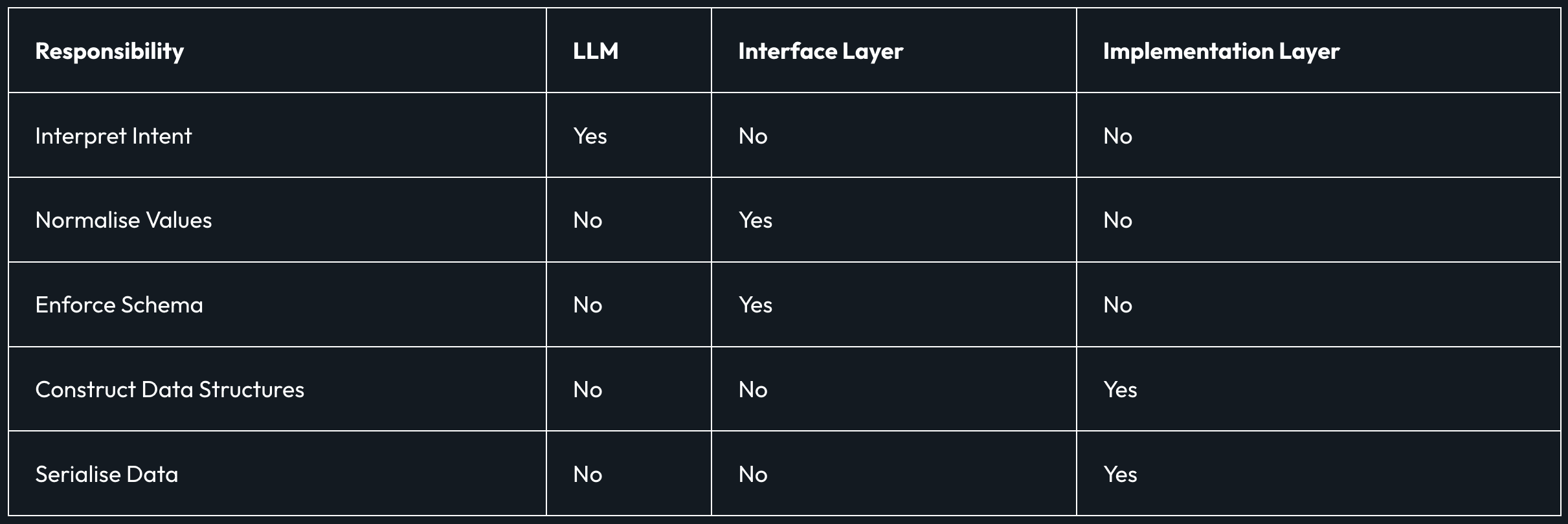
Core Principle
LLMs Plan. Code Types.
Never let the model define structure.
Always enforce structure at the boundary.
Summary
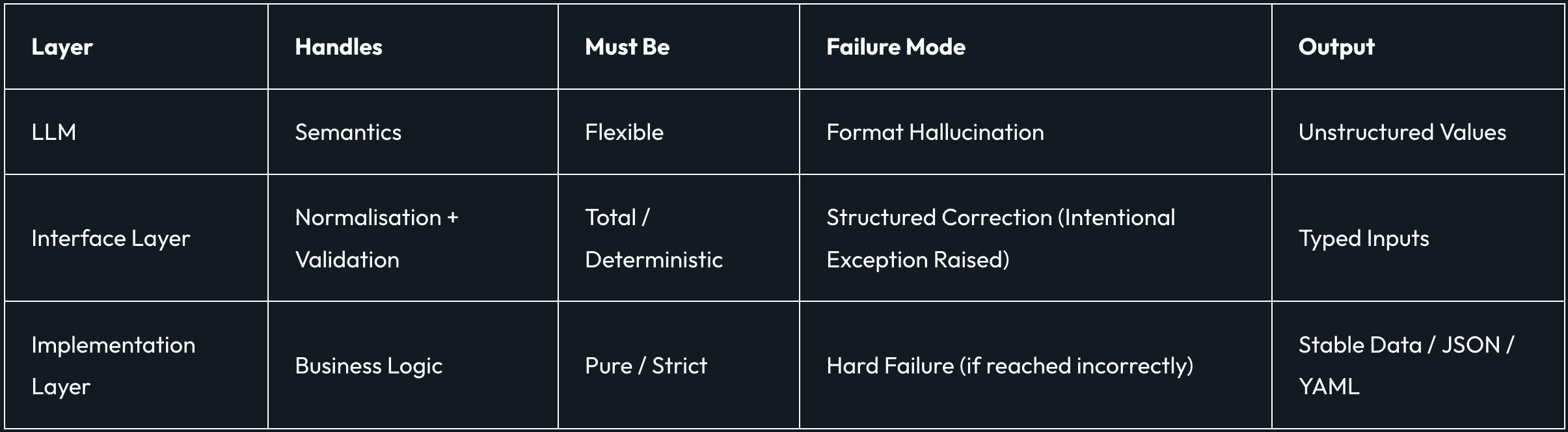
The invariant:
If the implementation layer sees garbage, the interface layer is incorrect.
This pattern is general and applies to every LLM-tooling integration, including MCP, ReAct, function-calling APIs, and agentic planning systems. This architecture is not a workaround for LLM weaknesses. The Adaptive Anti-Corruption Layer is the correct separation of concerns for any system in which a probabilistic language generator interacts with deterministic software components.
Related Patterns
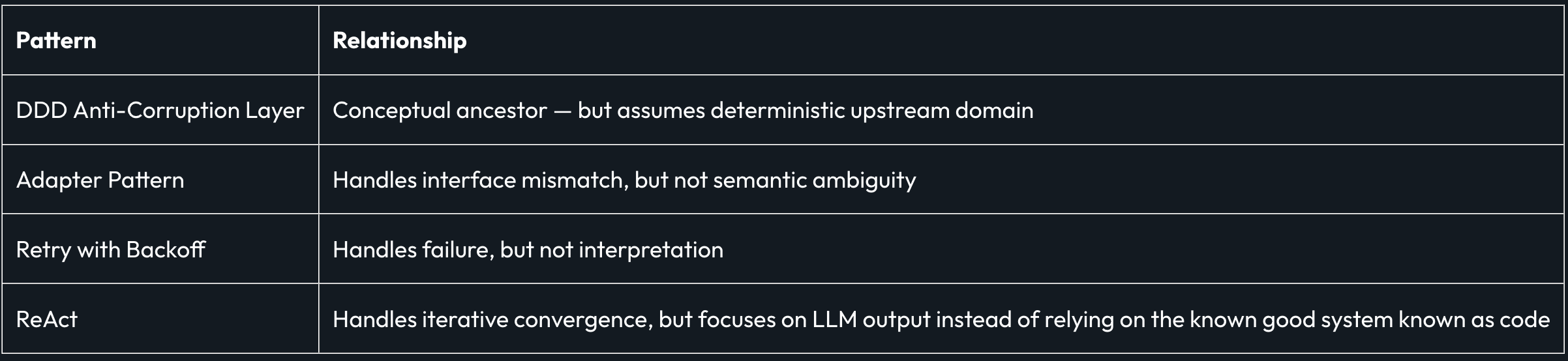
Pattern Formalisation (Appendix)
For pattern catalogue inclusion.
Applicability
Use the AACL pattern when:
Integrating LLMs with deterministic APIs, databases, or business logic
Building function-calling or tool-use systems
Creating MCP servers or LLM integration points
Generating structured data (JSON, YAML) from LLM outputs
Do not use when:
Input is already strictly typed (traditional API)
Format variation is acceptable downstream
Only semantic correctness matters (content, not format)
Consequences
Benefits:
Eliminates silent format corruption
Enables self-healing via structured errors
Clear separation of concerns
Works with any LLM (no retraining) that supports function calling
Composable with existing frameworks
Trade-offs:
Requires two-layer architecture
Normalisation adds (minimal) latency
Interface must evolve with edge cases
Does not solve content hallucinations
Known Uses
OpenAI/Anthropic function calling APIs
MCP server implementations
LangChain custom tools
Agentic systems
Any LLM-to-database/API boundary
Forces Resolved
The pattern balances:
Flexibility vs. Correctness: LLM freedom + type safety
Fail-Fast vs. Teach: Structured errors guide correction
When to Normalise vs. Validate: Intentional design choice per parameter
Boundary Location: Interface handles ambiguity, implementation stays pure
The resolution: Interface layer is total (handles all inputs), implementation is pure (assumes correctness).
---
## About This Pattern
**Author:** Morgan Lee
**Organisation:** Synpulse8
**First Published:** 12 November 2025